
Understanding Custom Vinyl Records and the Pressing Process
The world of custom vinyl has transformed dramatically since 2010, when the vinyl revival began gaining serious momentum. Today, creating a personalized vinyl record involves choosing between two primary methods: traditional pressing plants that use steam-powered hydraulic presses with metal stampers, or modern lathe-cutting services that carve grooves directly into blank discs one at a time. Traditional pressing plants like Furnace Record Pressing in Virginia, Cascade Record Pressing in Oregon, and Hand Drawn Pressing in Texas handle the majority of commercial custom vinyl production in the United States, with each facility processing thousands of orders annually. These plants create a metal stamper from your audio master, then use that stamper to press hundreds or thousands of identical copies with consistent quality.
Lathe-cut vinyl represents the alternative approach for those wanting to make your own vinyl in smaller quantities. Services like American Vinyl Co., Vinylify, and One Cut Vinyl use precision lathes equipped with heated cutting heads that engrave the audio signal directly into polycarbonate or PVC blanks. This method eliminates the need for expensive stamper creation, making it economically viable for runs as small as a single copy. However, lathe-cut records typically exhibit higher surface noise, reduced frequency response (particularly in bass frequencies), and shorter lifespan compared to pressed vinyl. For collectors just beginning their journey, understanding these fundamental differences is as important as learning the distinctions between LP, EP, and single formats when building a comprehensive collection.
The technical process for professional pressing begins with audio mastering specifically optimized for vinyl. Unlike digital mastering, vinyl requires careful attention to phase relationships, bass frequencies below 150Hz, and excessive sibilance in the 6-10kHz range. Professional mastering engineers like Kevin Gray at Cohearent Audio or Bernie Grundman at Bernie Grundman Mastering charge $400-$800 per side for vinyl-specific mastering that ensures your custom record sounds its absolute best. This mastered audio is then cut to a lacquer disc using a lathe, plated with nickel to create a metal negative (the father), from which a positive (the mother) and then multiple negatives (stampers) are generated through electroplating processes.
Cost Breakdown: Budgeting for Your Custom Vinyl Project
Creating custom vinyl requires careful financial planning, as costs vary dramatically based on quantity, format, and specifications. For a standard 12-inch LP pressing run of 100 copies in black vinyl with printed inner sleeves and basic jacket printing, expect to invest $1,800-$2,500 total at mid-tier pressing plants like Pirates Press or Gotta Groove Records. This breaks down to approximately $18-$25 per unit, which includes lacquer cutting ($150-$300), plating and stamper creation ($250-$400), test pressings ($75-$150 for 5 copies), pressing labor, vinyl material, and basic packaging. Increasing your quantity to 300 units typically reduces the per-unit cost to $10-$15, as the fixed costs of lacquer cutting and plating are distributed across more copies.
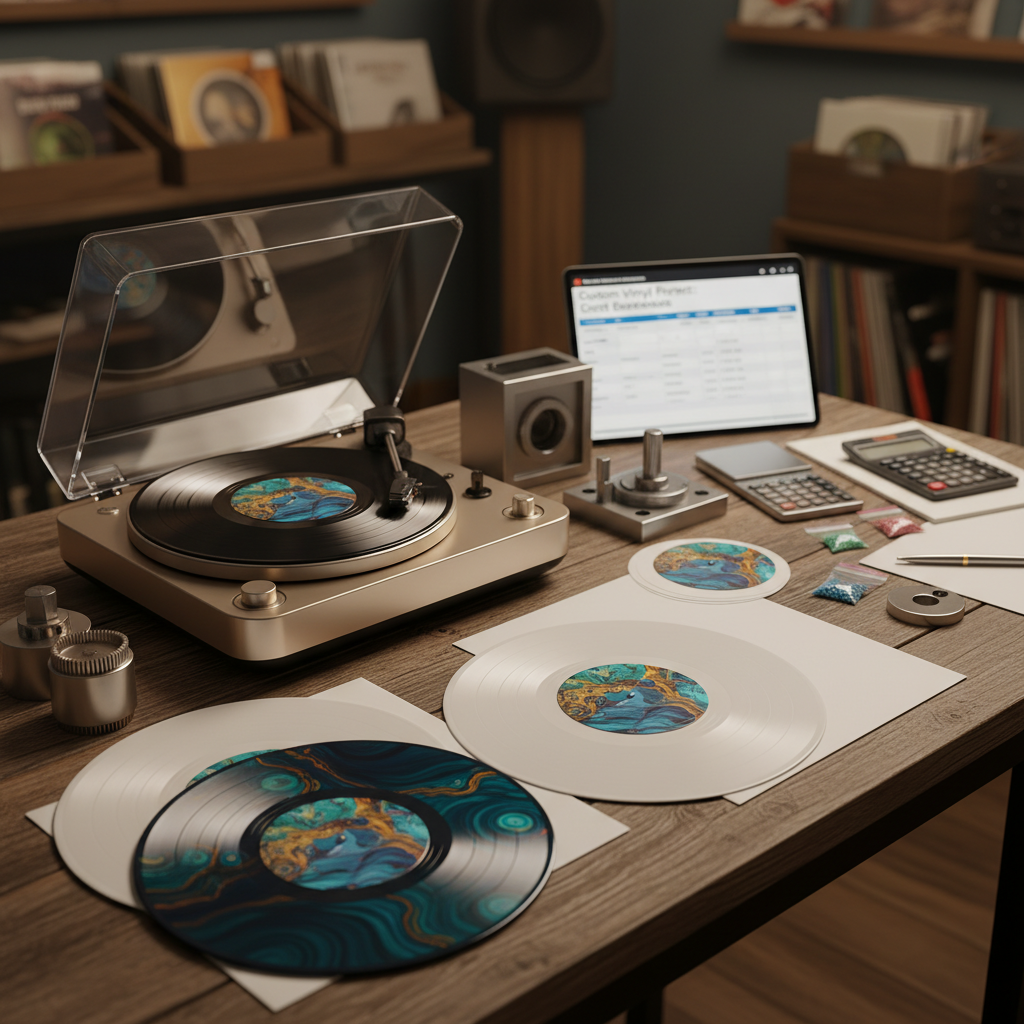
Premium options significantly increase costs but deliver superior results. 180-gram audiophile pressings add $0.50-$1.00 per unit compared to standard 140g weight. Colored vinyl typically costs an additional $0.30-$0.75 per record, while specialty variants like splatter, marble, or picture discs can add $1.50-$3.00 per unit. Gatefold jackets increase packaging costs by $1.00-$2.00 per copy compared to single-pocket sleeves. For those wanting to create just one or two copies, lathe-cut services offer more accessible pricing: American Vinyl Co. charges $40-$50 for a single 12-inch LP, while Vinylify's prices start at $35 for a 7-inch single and $89 for a 12-inch album. Tools like VinylAI can help you track your collection's value and understand market pricing for similar releases, which proves invaluable when deciding on production quantities and pricing strategies for custom releases intended for sale.
Beyond the pressing costs themselves, budget for essential ancillary expenses. Professional vinyl mastering runs $400-$800 as mentioned, though some pressing plants offer in-house mastering for $200-$400 that may suffice for less critical projects. Graphic design for labels and jackets costs $300-$1,500 depending on complexity and whether you hire professionals or use templates. Shipping from the plant to your location adds $100-$300 for 100-unit runs, with costs scaling based on quantity and destination. International pressing plants like Optimal Media in Germany or Record Industry in the Netherlands often offer competitive pricing but require navigating customs, longer lead times of 16-24 weeks, and potential import duties of 3-8% of the shipment value.
Choosing the Right Pressing Plant or Service for Your Needs
Selecting the appropriate manufacturer for your personalized vinyl record project requires evaluating several critical factors beyond just pricing. Pressing plant capacity and lead times vary wildly across the industry—as of 2024, most established plants operate at near-full capacity with waiting lists extending 12-20 weeks from order placement to delivery. Furnace Record Pressing, known for exceptional quality and working with labels like Numero Group and Light in the Attic, typically quotes 16-18 week turnarounds. Cascade Record Pressing in Portland maintains similar timelines but specializes in environmentally conscious production using recycled PVC when possible. For faster turnaround, smaller operations like Capsule Labs in Los Angeles or Hand Drawn Pressing in Dallas sometimes offer 8-12 week production for rush orders with premium fees of 15-25% added to base costs.
Quality reputation matters immensely when choosing where to make your own vinyl. Research pressing plant track records through online forums like the Vinyl Collective community or the Hoffman Forums, where engineers and labels discuss their experiences with specific facilities. Third Man Pressing in Detroit, operated by Jack White's Third Man Records, has built a stellar reputation for quality control and attention to detail, though their services primarily focus on Third Man releases and select outside projects. Pressed vinyl quality depends on factors including press maintenance, temperature control precision, vinyl compound purity, and operator expertise—variables that separate exceptional plants from mediocre ones. Request sample pressings from plants you're considering; reputable facilities will provide examples of their work, allowing you to assess surface noise levels, clarity, and overall fidelity.
For lathe-cut alternatives, evaluate providers based on equipment quality and customer reviews. American Vinyl Co. uses Vinylrecorder T560 lathes from Germany, considered among the best consumer-grade cutting systems available, producing lathe cuts that approach pressed vinyl quality at the high end of the spectrum. One Cut Vinyl operates vintage Neumann VMS-70 lathes originally designed for professional mastering, delivering superior results but at higher price points of $60-$80 per 12-inch disc. Vinylify targets the gift market with streamlined ordering and attractive packaging but uses lower-end equipment that prioritizes novelty over audiophile quality. When starting your custom vinyl journey, understanding quality benchmarks becomes as important as learning proper grading standards for evaluating collectible records in your existing collection.
Audio Preparation and Mastering for Vinyl Format
Proper audio preparation represents the most critical technical aspect of creating high-quality custom vinyl records. Unlike digital formats that can accommodate extreme dynamic range and unlimited frequency response, vinyl imposes physical limitations that require specialized mastering. Bass frequencies below 100Hz must be carefully managed and often converted to mono, as excessive stereo bass causes groove spacing issues and tracking problems. Extreme high frequencies above 15kHz need de-emphasis to prevent sibilance distortion and excessive groove modulation that can cause the stylus to mistrack. Professional mastering engineers use specialized equipment like Neumann VMS-80 or Scully lathes during the cutting process, with real-time monitoring to ensure the audio translates properly to the physical medium.

The mastering process for vinyl differs fundamentally from digital mastering in several key areas. Dynamic range compression must be applied more conservatively—while modern digital releases often exhibit 6-8 dB of dynamic range due to loudness wars, vinyl masters typically preserve 10-14 dB to prevent distortion and maintain fidelity. Total program length affects quality significantly: a 12-inch LP running 18-20 minutes per side at 33⅓ RPM delivers optimal sound quality, while extending to 25+ minutes per side requires tighter groove spacing that reduces bass response and increases surface noise. For maximum fidelity, consider shorter programs or 45 RPM pressings, which offer approximately 30% better sound quality than 33⅓ RPM at the cost of reduced playing time (12-14 minutes per side maximum).
If you're handling audio preparation yourself before sending files to a pressing plant, follow these technical specifications: provide 24-bit/96kHz WAV or FLAC files with peaks no higher than -3dBFS to allow headroom for the cutting engineer. Avoid brick-wall limiting or excessive compression—your files should breathe dynamically. Include 2-3 seconds of silence before the first track and after the last track on each side. For albums requiring track splits, provide a separate cue sheet or detailed timing notes indicating where tracks begin. Many pressing plants offer vinyl mastering services for $200-$400 that handle these technical requirements, though dedicated mastering studios like Sterling Sound ($600-$1,000 per project) or Abbey Road Studios ($800-$1,500) deliver results that justify the premium for serious releases. Understanding these technical requirements helps you make informed decisions, similar to how knowing the fundamentals of starting a vinyl collection guides your purchasing choices as a collector.
Design Options: Labels, Jackets, and Packaging Choices
The visual presentation of your custom vinyl project significantly impacts its appeal and perceived value, whether you're creating artist merchandise, limited edition releases, or personal keepsakes. Standard packaging options include single-pocket jackets (the most economical choice), gatefold jackets that open like a book providing space for additional artwork or liner notes, and tip-on gatefolds where the printed material is glued to a thicker cardboard base for premium feel. Pirates Press offers comprehensive packaging templates showing that single-pocket jackets cost approximately $0.80-$1.20 per unit for runs of 100-300 copies, while gatefold jackets run $1.80-$2.50 per unit. Jacket printing quality varies from basic 1-color designs to full-color CMYK with spot varnish, metallic inks, or embossing that can add $0.50-$2.00 per unit depending on complexity.
Label design offers creative opportunities ranging from simple typed labels to full-color custom artwork. Most pressing plants provide standard label templates in various sizes: 4-inch diameter for 12-inch records and 2.5-inch for 7-inch singles. Full-color label printing typically costs $0.15-$0.30 per label (two labels per record), while specialty options like metallic labels, die-cut shapes, or holographic effects add $0.40-$0.80 per record. Consider including essential information on your labels: artist name, album/song title, side designation (A/B), catalog number if applicable, and copyright information. Inner sleeves present another customization opportunity—plain white paper sleeves cost $0.10-$0.15 each, while printed inner sleeves with lyrics, photos, or artwork run $0.30-$0.50 each. Anti-static poly-lined inner sleeves, preferred by collectors for protection, cost $0.25-$0.40 each and significantly improve the listening experience by reducing static-related pops and clicks.
For those creating display-worthy custom pressings, explore premium packaging options. PVC outer sleeves protect the jacket and cost $0.30-$0.50 per unit when ordered through pressing plants. Shrink-wrapping adds $0.15-$0.25 per unit and provides tamper-evident sealing for commercial releases. Some collectors creating personal projects opt for premium solutions like Japanese-style OBI strips ($0.40-$0.80 each) or custom stickers and inserts. When planning your packaging strategy, consider how you'll eventually store and display these records—the same principles that apply to organizing and showcasing your existing collection should inform your custom vinyl packaging decisions to ensure long-term preservation and visual appeal.
Design file preparation requires attention to technical specifications to avoid costly reprinting. Most pressing plants require jacket artwork as high-resolution PDFs (300 DPI minimum) with appropriate bleed areas—typically 0.125 inches beyond the trim line. Color profiles should use CMYK rather than RGB to ensure accurate color reproduction. Include crop marks, bleed guides, and safety margins in your design files. For label artwork, provide vector files (AI or EPS format) or high-resolution raster files (TIFF or PDF) at actual size. Many plants offer design templates downloadable from their websites; Gotta Groove Records and Furnace Record Pressing both provide comprehensive template packages for various formats and packaging options. If design isn't your strength, budget $300-$800 for professional graphic design services, or explore more affordable options like Fiverr designers ($50-$200) who specialize in vinyl packaging and understand the technical requirements.
Comparing Custom Vinyl Options: A Detailed Analysis
Understanding the trade-offs between different custom vinyl production methods helps you make informed decisions based on your specific needs, budget, and quality expectations. The table below compares the three primary approaches to creating personalized vinyl records, highlighting key differences in cost, quality, and practical considerations:
| Factor | Professional Pressing (100+ units) | Short-Run Pressing (25-100 units) | Lathe-Cut (1-25 units) |
|---|---|---|---|
| Cost per unit | $10-$25 | $25-$45 | $35-$80 |
| Minimum quantity | 100-300 units | 25-100 units | 1 unit |
| Production time | 12-20 weeks | 8-16 weeks | 2-6 weeks |
| Sound quality | Excellent (professional grade) | Very good to excellent | Good (higher surface noise) |
| Durability | 500+ plays typical | 400-500 plays | 100-200 plays |
| Best for | Album releases, commercial sales | Limited editions, test marketing | Gifts, prototypes, personal use |
This comparison reveals that professional pressing plants deliver the best value for projects exceeding 100 copies, with superior sound quality and durability justifying the higher minimum quantities and longer wait times. Short-run pressing services like Capsule Labs or Tangible Formats fill the middle ground, offering pressed vinyl quality at quantities as low as 25 units, though per-unit costs increase significantly. These services often use the same pressing equipment and processes as larger plants but accommodate smaller batches by grouping multiple projects together or charging premium rates to offset setup costs.
Lathe-cut services excel for specific use cases despite their limitations. Wedding couples creating unique guest favors, podcasters producing limited promotional copies, or artists testing market interest before committing to full pressing runs all benefit from lathe-cutting's flexibility and low minimum quantities. However, serious collectors and audiophiles will immediately notice the quality differences—lathe-cut records typically exhibit 3-6 dB higher surface noise, reduced bass response below 80Hz, and faster wear rates due to the cutting process creating rougher groove walls compared to stamped pressings. For projects intended as serious additions to your collection or for critical listening, professional pressing remains the gold standard, delivering the quality you'd expect from commercially released records that meet industry-standard grading criteria.
Special Considerations: Picture Discs, Colored Vinyl, and Unique Formats
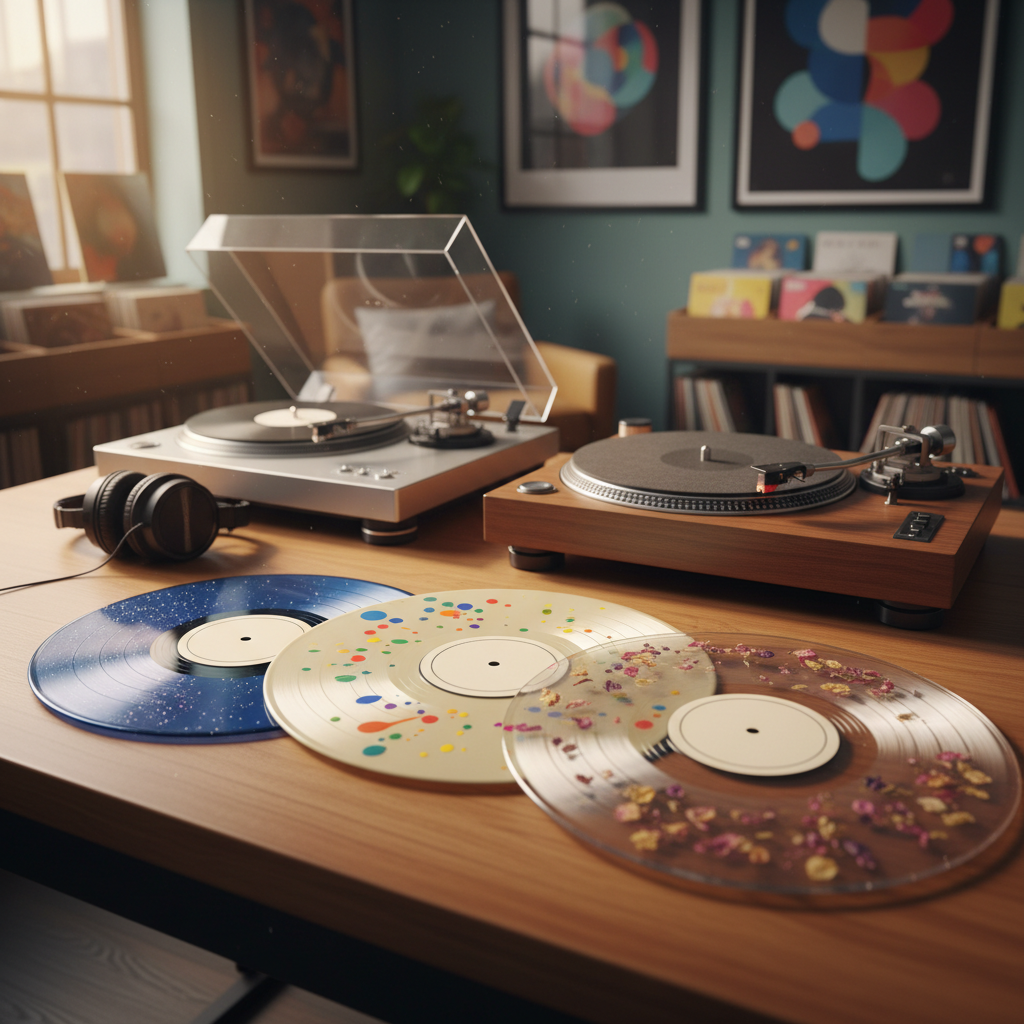
Beyond standard black vinyl pressings, custom vinyl projects can incorporate various specialty formats that enhance visual appeal and collectibility. Colored vinyl represents the most accessible specialty option, with pressing plants offering extensive color palettes ranging from translucent variants (clear, red, blue, green, yellow) to opaque colors (white, pink, orange, purple) at modest premiums of $0.30-$0.75 per unit over black vinyl. More complex variants like splatter (random color patterns), marble (swirled colors), or tri-color combinations increase costs to $1.50-$2.50 per unit due to the manual labor required during pressing. Independent Pressing in New Jersey and Erika Records in California have built reputations for exceptional colored vinyl work, consistently producing vibrant, well-defined color patterns that collectors prize.
Picture discs—records with printed images visible through clear vinyl—create striking visual presentations but involve sound quality compromises. The picture disc construction sandwiches a printed image between two thin layers of clear vinyl, creating a thicker, less acoustically optimal structure than standard pressings. This results in increased surface noise (typically 6-10 dB higher than standard pressings), reduced dynamic range, and more pronounced tracking challenges. Picture disc production costs $3.00-$5.00 per unit more than standard pressings, with minimum quantities often higher (200-300 units) due to setup complexity. Despite these limitations, picture discs command collector interest and often sell at premium prices—Discogs data shows picture disc variants of popular albums selling for 150-300% of standard pressing prices, making them potentially worthwhile for limited edition releases or special commemorative projects.
Alternative formats expand creative possibilities for custom vinyl projects. 7-inch singles at 45 RPM offer excellent sound quality for shorter programs (4-6 minutes per side maximum), with pressing costs of $1.00-$2.00 per unit for runs of 300+ copies. 10-inch records split the difference between 7-inch and 12-inch formats, providing 10-12 minutes per side at 33⅓ RPM or 7-9 minutes at 45 RPM, though fewer pressing plants offer this format. Shaped records (non-circular vinyl cut to custom shapes) create ultimate visual impact but require specialized cutting dies ($800-$2,000 setup cost) and involve significant sound quality compromises due to off-center grooves and limited playing surface. For collectors interested in these specialty formats, understanding their unique characteristics proves as valuable as knowing the fundamental differences explained in guides covering LP versus EP versus single formats.
Quality Control, Testing, and Final Considerations
Implementing rigorous quality control processes ensures your custom vinyl project meets expectations and avoids costly reprinting. Professional pressing plants include test pressings as a standard service—typically 3-5 copies pressed from your stampers before the full production run begins. These test pressings, which cost $75-$150 depending on the plant, allow you to verify audio quality, check for pressing defects, and confirm that your master translated correctly to vinyl. Allocate 2-3 weeks in your production timeline for test pressing review; rushing this critical step risks approving flawed pressings that will disappoint recipients or customers. Listen to test pressings on quality playback equipment, checking specifically for surface noise, tracking issues, distortion during loud passages, and proper channel separation.
Common defects to watch for during test pressing evaluation include non-fill (incomplete groove formation causing dropouts), dishing (warping that causes the record to curve), off-center holes causing wow and flutter, and excessive surface noise from contaminated vinyl compound or dirty stampers. Document any issues with specific timestamps and detailed descriptions when communicating with your pressing plant. Reputable facilities will address legitimate defects by adjusting pressing parameters, cleaning or replacing stampers, or re-cutting lacquers if the problem originated during mastering. Some plants charge for additional test pressing rounds ($50-$100), while others include one revision in their base pricing—clarify these policies before committing to a manufacturer.
After approving test pressings and receiving your final production run, implement incoming quality checks on a sample of finished records. For a 300-unit run, inspect at least 10-15 copies randomly selected from different areas of the shipment, checking for consistent pressing quality, proper label application, jacket printing accuracy, and packaging integrity. Store your custom vinyl records properly using archival-quality inner sleeves, maintaining vertical orientation in climate-controlled environments (65-70°F, 45-50% relative humidity) to prevent warping and deterioration. For records intended as long-term collectibles or archival preservation, consider creating digital backups of your masters and storing them separately—while vinyl offers unique sonic characteristics and tactile appeal, digital archives ensure your audio survives even if physical copies deteriorate. Whether you're creating custom pressings for commercial release or personal enjoyment, applying the same care and storage principles you use for valuable collectibles in your existing collection will ensure these personalized records remain playable for decades.