 VinylAI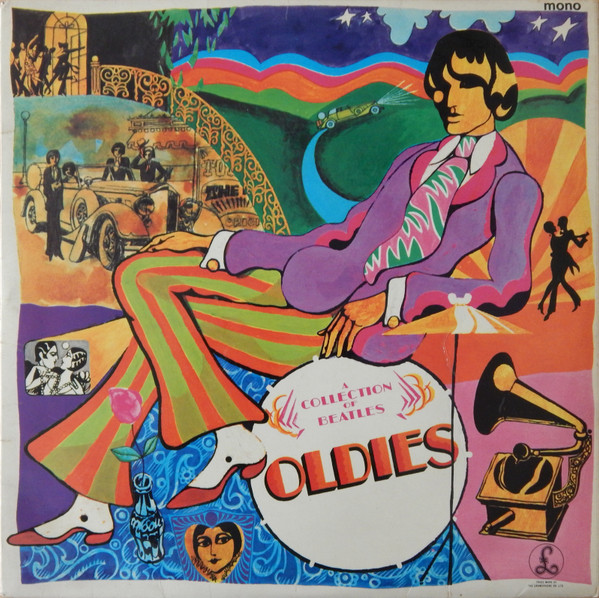
Data as of Jun 16, 2026
The Beatles – A Collection Of Beatles Oldies
1966 · UK · Parlophone · Vinyl LP Album Compilation Mono
Be the first to list yours, or get an email the moment a copy appears.
Offers
New to condition grades like NM or VG? Read our vinyl grading guide →
Pressing identification
Match these against your copy to confirm the exact pressing.
- Runout — side A
- XEX.619XEX 619-1GXEX 619-1G MMXEX 619-1G TM 1XEX 619-1G GT 3XEX 619-1G PA 3XEX 619-1G GG 1XEX 619-1G O H 1XEX 619-1G RP 3XEX 619-1G M 1XEX 619-1G LA 3
- Runout — side B
- XEX.620XEX 620-1GXEX 620-1G GAXEX 620-1G LT 3XEX 620-1G RD 1XEX 620-1G LG 2XEX 620-1G AR 2XEX 620-1G OP 2XEX 620-1G RO 3XEX 620-1G M 1XEX 620-1G GGD 4
- Rights society
- NCB, Mecolico
- Other
- KT(Tax Code on label, var. 1)
- Other
- MT(Tax Code on label, var. 2)
- Other
- KT(Tax Code on label, var. 3)
- Other
- KT(Tax Code on label, side B, var. 4)
- Other
- KT(Tax Code on label, side B, var. 5)
- Other
- KT(Tax Code on label, side B, var. 6)
- Other
- KT(Tax Code on label, side B, var. 7)
- Other
- KT(Tax Code on label var. 8)
- Other
- KT(Tax Code on label var. 9)
- Other
- KT(Tax Code on label var. 10)
- Record Company
- E.M.I. Records
- Record Company
- The Gramophone Co. Ltd.
- Printed By
- Garrod & Lofthouse Ltd.
- Made By
- Garrod & Lofthouse Ltd.
- Pressed By
- The Gramophone Co. Ltd.
Specifications
- Artist
- The Beatles
- Style
- Beat, Pop Rock, Rock & Roll
- Year
- 1966
- Label
- Parlophone
- Catalog number
- PMC 7016
- Country
- UK
Tracklist
- A1She Loves You
- A2From Me To You
- A3We Can Work It Out
- A4Help!
- A5Michelle
- A6Yesterday
- A7I Feel Fine
- A8Yellow Submarine
- B1Can't Buy Me Love
- B2Bad Boy
- B3Day Tripper
- B4A Hard Day's Night
- B5Ticket To Ride
- B6Paperback Writer
- B7Eleanor Rigby
- B8I Want To Hold Your Hand
- Producer
- George Martin
- Written-By
- Lennon-McCartney
- Photography By [Back Cover]
- Robert Whitaker
About this record
The mono pressing of A Collection Of Beatles Oldies (PMC 7016) carries two distinct label variations that determine authenticity and collector value. The second variation, MR1A(ii), positions the catalogue number 7016 to the right of the word LISTS, a detail Bruce Spitzer's discography uses to separate genuine pressings from the earlier MR1A(i) variant.
Stamped runouts XEX 619 and XEX 620 mark pressings from either Garrod & Lofthouse Ltd. or The Gramophone Co. Ltd., and the laminated flipback sleeve bears the small mono designation in the upper right corner. Across 70 copies currently for sale, prices span from 11.33 USD at the floor to 147.64 USD in Mint condition.
What drives its value
Condition drives the entire market for this 1966 UK mono compilation. A Mint copy commands 147.64 USD, while NM drops to 132.09 USD—a gap that reflects the rarity of unplayed stock.
VG+ copies trade at 101.01 USD, and VG at 69.93 USD, marking the threshold where wear becomes visible to the naked eye. The lowest asking price of 11.33 USD appears on heavily played or damaged copies; 70 listings exist across the market.
Among 3540 collectors who own PMC 7016, 430 still want one, signaling sustained demand despite its 1966 release date. The stereo variant PCS 7016 exists as an alternative, but the mono pressing remains the original UK issue.
Label variation MR1A(ii) adds specificity that separates casual copies from those documented in Spitzer's reference.
How to appraise this pressing
Confirm PMC 7016 on the spine and back cover upper right, paired with the text Also available on Stereo No. PCS 7016. The label itself must show the second variation MR1A(ii), where 7016 sits to the right of the final s in LISTS.
Examine the dead wax for stamped runouts: either XEX 619 or XEX 620 (or their 1G variants) indicates the pressing plant—Garrod & Lofthouse Ltd. or The Gramophone Co. Ltd. The sleeve must be laminated flipback with a small mono designation in the upper right front corner, printed by Garrod and Lofthouse. Check the copyright notices on the label: A1, A2, B8 bear 1963; A7, B1, B4 bear 1964; A3, A4, A5, A6, B2, B3, B5 bear 1965; A8, B6, B7 bear 1966.
All 16 tracks should be present. Grade by surface noise, groove wear, and sleeve lamination integrity; the flipback construction is prone to separation.
Further reading: grading a record, what makes a pressing valuable.
Listen
Hear the album before you buy.
Official videos via YouTube.
Release notes
Front laminated flipback sleeve.
The mono covers of this release have a small “mono” designation in the upper right front corner. “PMC 7016”, as well as “Also available on Stereo No. PCS 7016” are printed on the back cover upper right corner. The covers are printed by Garrod and Lofthouse, and no Ernest J Day mono covers have been confirmed.
According to Bruce Spitzer’s 'The Beatles for Sale on Parlophone Records', there are two mono label variations for this release; the one pictured here is the second mono label variation, which he identifies as MR1A(ii). In this variation, the catalogue number ‘7016’ just out to the right, past the last ‘s’ in the word ‘LISTS’, directly above it, on the right side of the labels.
In the first mono label variation, identified as MR1A(i), the ‘6’ in 7016 is right aligned with the last ‘s’ in ‘LISTS’.
℗ 1963 - A1, A2, B8. ℗ 1964 - A7, B1, B4. ℗ 1965 - A3, A4, A5, A6, B2, B3, B5. ℗ 1966 - A8, B6, B7.
On labels: • SOLD IN U.K. SUBJECT TO RESALE PRICE CONDITIONS SEE PRICE LISTS • MADE IN Gt. BRITAIN
Runouts are stamped.
Notes sourced from the Discogs database.
Other pressings of this release
Different editions of the same album — pressing decides value.
Frequently asked
What is the difference between PMC 7016 and PCS 7016?
PMC 7016 is the mono pressing; PCS 7016 is stereo. Both were released in 1966 on Parlophone in the UK. The back cover of PMC 7016 explicitly states Also available on Stereo No. PCS 7016, confirming the stereo variant existed simultaneously. Mono copies carry the small mono designation in the upper right front corner of the sleeve.
What does the label variation MR1A(ii) mean, and why does it matter?
Bruce Spitzer's discography identifies two mono label variations for this release. In MR1A(ii), the catalogue number 7016 is positioned to the right of the final s in the word LISTS. In MR1A(i), the 6 in 7016 aligns directly with that final s. MR1A(ii) is the second and more commonly documented variation. Confirming the correct variation proves the pressing is authentic and helps date it within the 1966 release window.
What is a VG+ copy worth?
According to the price guide, a VG+ copy is valued at 101.01 USD. This estimate reflects market data as of the guide's publication date. VG+ indicates light surface noise and minimal groove wear visible under normal play. The jump from VG (69.93 USD) to VG+ (101.01 USD) reflects the collector preference for copies that play without audible distortion.
How do I identify the pressing plant from the runout?
Stamped runouts in the dead wax read either XEX 619 or XEX 620 (or their 1G variants). These matrix codes correspond to two pressing plants: Garrod & Lofthouse Ltd. and The Gramophone Co. Ltd. The specific plant assignment requires cross-reference with Spitzer's discography or Discogs pressing notes, as the runout alone does not indicate which plant produced which side. Both plants manufactured legitimate UK pressings in 1966.
Why is the lowest price only 11.33 USD when VG copies are 69.93 USD?
The lowest price of 11.33 USD represents heavily damaged or unplayable stock—copies graded Poor (P) or Fair (F), which sell at 7.77 USD and 15.54 USD respectively in the price guide. These copies may have deep scratches, warping, or label damage that makes them suitable only for display or parts. The 70 copies currently for sale include the full spectrum of conditions, so the floor price reflects the worst available stock, not typical market value.